
Watch the Quick Statutory Summary
Daily corporate compliance • Follow our official handle for statutory deadline alerts.
Your enterprise is scaling smoothly, monthly sales are growing, and your supply chain is humming along. Then, late one evening, an email notification lands from the GST portal: Form ASMT-10 or Form DRC-01 intimation.
For most business owners and directors, the immediate reaction is panic.
Some founders rush to pay the demanded amount blindly just to clear the issue, while others procrastinate, assuming their accountant will handle it whenever they find time.
Both reactions are dangerous. Paying blindly can mean conceding liabilities that your vendors should have borne, while ignoring a notice can lead directly to frozen corporate bank accounts and recovery summons.
In today's automated GST administration, notices are generated by automated analytical algorithms cross-referencing millions of data points across GSTR-1, GSTR-3B, and GSTR-2B with zero human intervention. A GST notice is not a final verdict—it is simply a formal query that demands a strategic, forensic response.
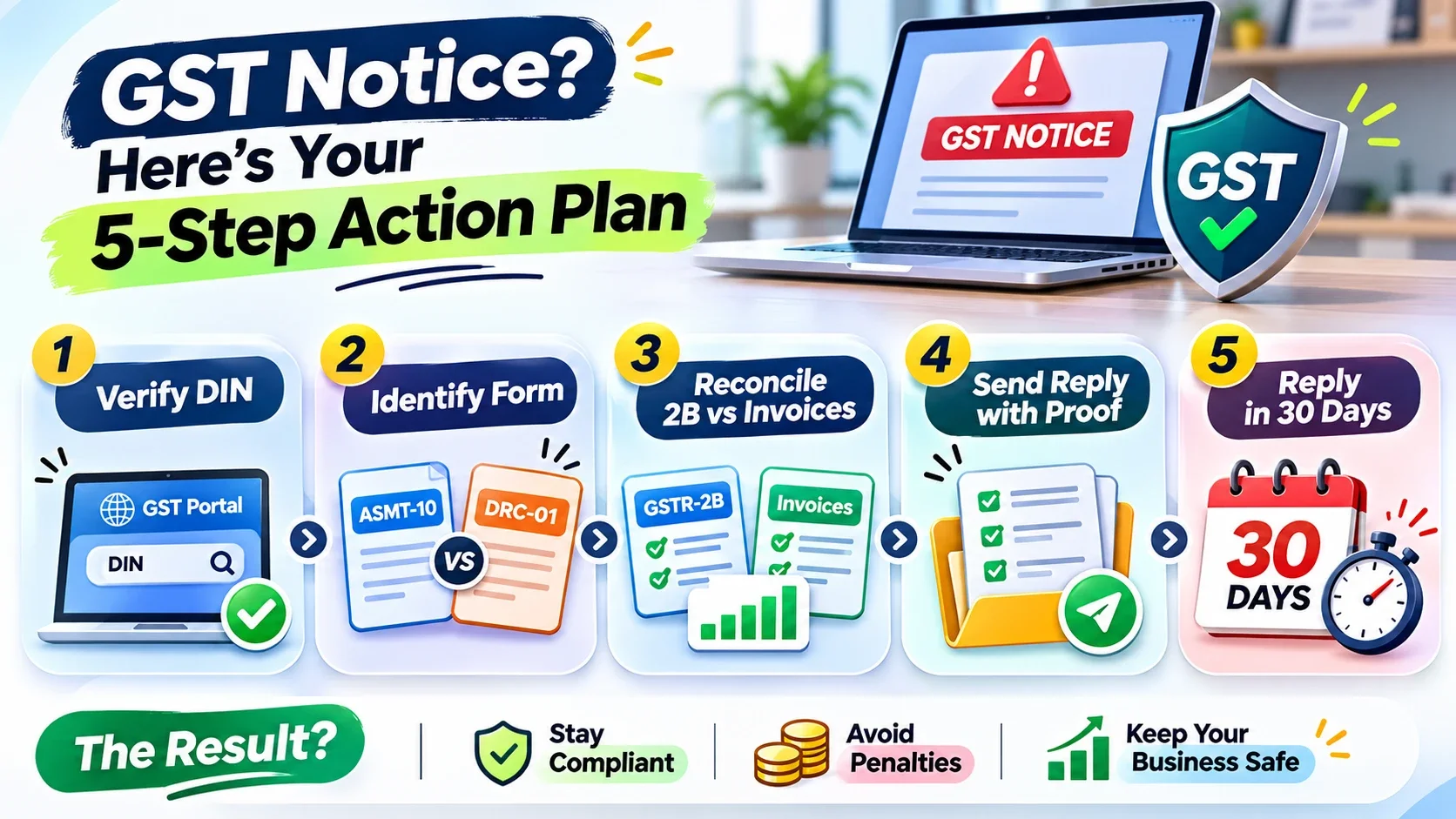
Here is the 5-step statutory defense protocol every business owner should follow.
1. Step One: Verify the Document Identification Number (DIN)
Never reply to an informal email, WhatsApp message, or unverified letter claiming to be from a GST authority. Under Central Board of Indirect Taxes and Customs (CBIC) circulars, every authentic GST notice, summons, or order must carry a unique, system-generated Document Identification Number (DIN).
- What to do: Log in to the official GST portal, navigate to the "Verify DIN" service, and enter the number printed on the notice. If the DIN does not resolve on the portal, the communication is legally invalid and non-binding.
2. Step Two: Decode the Exact Statutory Section
GST notices are not all the same. The legal burden of proof changes completely depending on which form you have received:
- Form ASMT-10 (Section 61 Scrutiny): This is an exploratory inquiry. The department has noticed discrepancies between your returns (such as outward supplies declared in GSTR-1 versus GSTR-3B, or Input Tax Credit claimed versus GSTR-2B). You are given 30 days to explain the variance via Form ASMT-11.
- Form DRC-01A (Section 73/74 Pre-Notice Intimation): The department is formally communicating proposed tax demands, interest under Section 50, and penalty calculations. This is your window to resolve or dispute before a full Show Cause Notice is issued.
- Form DRC-01 (Formal Show Cause Notice): A formal legal charge has been established. You must file a detailed legal defense in Form DRC-06 and request a personal hearing before an adjudication order is passed.
- Form DRC-01B & DRC-01C: Automated portal notices demanding immediate explanation for liability mismatches (1B) or excess ITC claims (1C). These must be answered electronically before the portal locks your subsequent GSTR-1 filings.
3. Step Three: Perform a Forensic Ledger Reconciliation
In over 75% of the scrutiny cases we handle at Taxorion Advisory Serviices, the alleged tax mismatch does not stem from tax evasion—it stems from clerical timing differences or vendor filing delays.
- Identify the root cause: Did your vendor fail to upload their GSTR-1 on time? Did they report your supply under B2C instead of B2B? Did your internal accounts team book ITC in a different tax period than when the tax invoice arrived?
- Gather the paper trail: Cross-reference the flagged transactions against your physical purchase register, bank payment statements proving actual consideration transfer, corresponding E-Way bills, and delivery challans.
4. Step Four: Draft an Evidence-Backed Factual Reply
A generic one-line reply saying "All our taxes have been paid" will be summarily rejected by the assessing officer.
- Your reply must be structured like a formal legal submission:
- Cite the relevant legal circulars and precedents (such as CBIC Circular 183/15/2022 on ITC discrepancies between GSTR-2A and GSTR-3B for early periods).
- Include invoice-by-invoice reconciliation annexures.
- Provide supplier confirmation certificates where third-party filing defaults occurred.
- Explicitly state in your concluding paragraph: "If the explanations submitted herein are not considered satisfactory, the taxpayer requests a Personal Hearing before any adverse order is passed."
5. Step Five: Strictly Respect the 30-Day Statutory Cutoff
Never let a notice linger past its deadline. Under the CGST Act, failing to respond within 30 days empowers the tax department to take aggressive administrative actions:
- Ex-Parte Best Judgment Orders (Section 73(9)): The proper officer can confirm the entire disputed tax amount, along with mandatory 18% compounding interest and up to 10% to 100% penalties, without further notice.
- Provisional Bank Account Attachment (Section 83): To protect government revenue, authorities have statutory powers to write directly to your bank and freeze current accounts, bringing daily payroll and operational vendor payments to an immediate halt.
- Revocation of E-Way Bill Generation: Your GST portal will block the generation of outward E-Way bills, halting all physical goods dispatches across state lines.
How Taxorion Protects Your Business
Handling a GST scrutiny notice requires a combination of forensic accounting and indirect tax litigation expertise. Submitting a hasty, poorly drafted explanation often locks your business into statements that cannot be undone during future appellate stages.
At Taxorion Advisory Serviices, our indirect tax litigation desk conducts line-by-line voucher audits, drafts clause-specific legal representations, and handles departmental appearances to protect your working capital and preserve your commercial standing.
Taxorion Advisory Editorial Board
Indirect Tax & Litigation Division